
Hyaluronic acid (HA)is one of the most popular ingredients in skincare. It's widely tolerated, appropriate for all skin types, inexpensive, and has a solid basis of clinical evidence to support hydration claims.
HA is a hydrating humectant that binds water at the surface, softening the look of fine lines and rough texture.
Results are surface-level, not structural, and discontinuing use will reverse progress almost immediately.
We recommend using HA as a supporting ingredient rather than the core of your skincare routine. It complements most ingredients, and is a particular friend to ceramides and niacinamide.
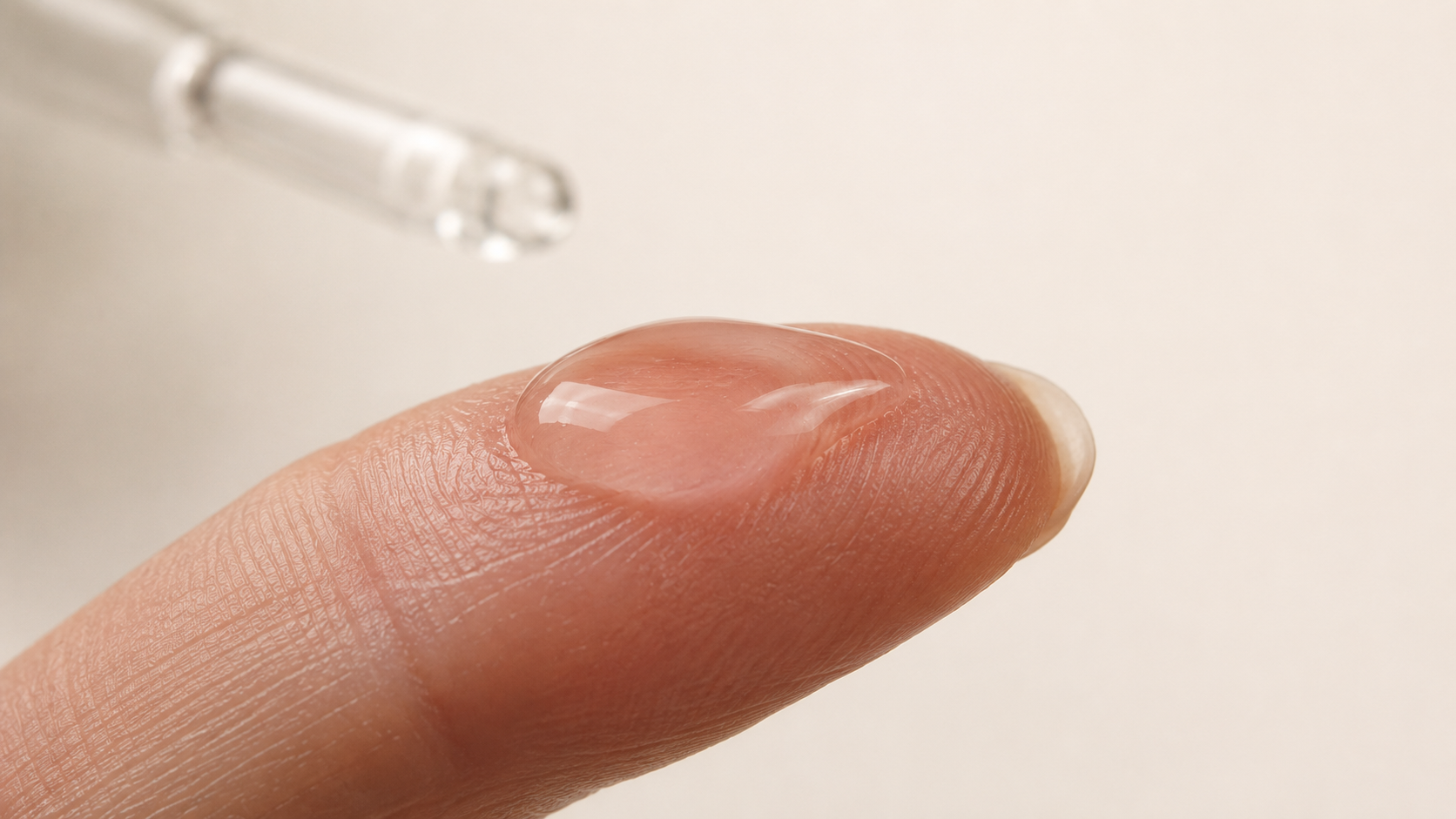
Most HA formulas sit at 0.1–2% concentration.
Molecular weights impact HA's performance more than concentration levels. Smaller HA molecules (under 50 kDa) penetrate deeper for more direct plumping, while larger ones (500–2,000 kDa) sit on the surface as a hydrating film.
The best formulations combine multiple weights to support the skin on multiple levels.
Hyaluronic acid has a reasonably strong basis of scientific research to support its core hydration claim. Other skin concerns have modest to limited evidence to support use of HA.
Pavicic et al. (2011) conducted a randomized, within-subject, vehicle-controlled study in 76 women over 60 days. All five 0.1% HA cream formulations significantly improved instrumental measures of hydration and elasticity; wrinkle-roughness measures improved significantly only with the 50 and 130 kDa formulations. Several authors were affiliated with ingredient suppliers, so the findings should be interpreted with appropriate attention to industry involvement.
Jegasothy et al. (2014) reported improved hydration and appearance-related measures after eight weeks in 33 women using a sponsor-supplied nano-HA product regimen, compared with untreated skin. The design was small and did not directly compare nano-HA with conventional HA, so it cannot prove molecular-weight superiority. Reviews such as Bukhari et al. (2018) describe molecular-weight-dependent HA behavior, but the clinical implications and safety of specific topical HA sizes remain formulation- and context-dependent.
HA has no known negative interactions, and is safe to add to any ingredient stack.
It is complementary to some of the most important ingredients in skincare:
No contraindications for pregnancy, breastfeeding, or general use.
Hyaluronic acid is a molecule your body already makes, with no concerns at cosmetic concentrations. It's among the best-tolerated actives in skincare, including sensitive and acne-prone skin.